
Write & Update Data
Write & Update Data
1. SQL Insertion
1.1 Syntax
In IoTDB, data insertion follows the general syntax:
INSERT INTO <TABLE_NAME> [(COLUMN_NAME[, COLUMN_NAME]*)]? VALUES (COLUMN_VALUE[, COLUMN_VALUE]*)Basic Constraints:
- Tables cannot be automatically created using
INSERTstatements. - Columns not specified in the
INSERTstatement will automatically be filled withnull. - If no timestamp is provided, the system will use the current time (
now()). - If a column value does not exist for the identified device, the insertion will overwrite any existing
nullvalues with the new data. - If a column value already exists for the identified device, a new insertion will update the column with the new value.
- Writing duplicate timestamps will update the values in the columns corresponding to the original timestamps.
- When an INSERT statement does not specify column names (e.g., INSERT INTO table VALUES (...)), the values in VALUES must strictly follow the physical order of columns in the table (this order can be checked via the DESC table command).
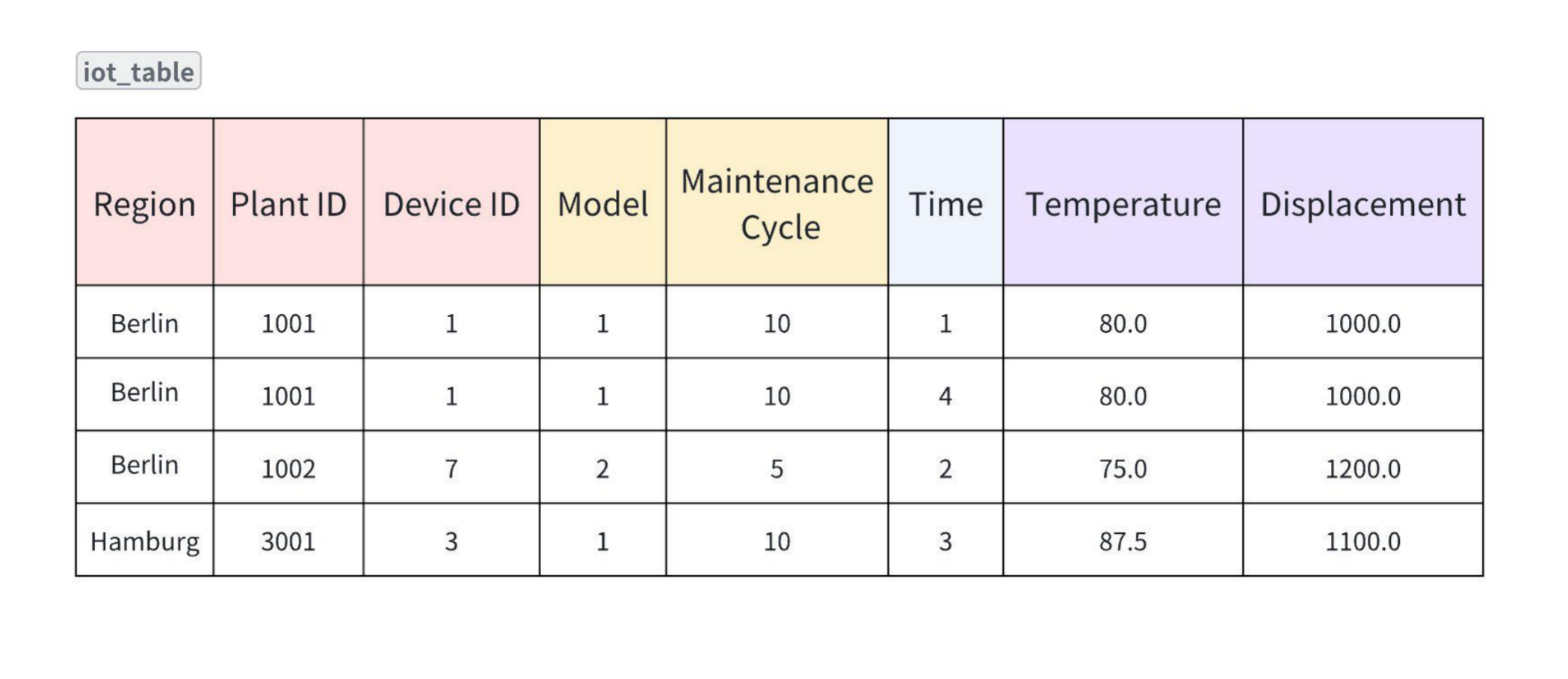
Since attributes generally do not change over time, it is recommended to update attribute values using the UPDATE statement described below,Please refer to the following Data Update.
1.2 Specified Column Insertion
It is possible to insert data for specific columns. Columns not specified will remain null.
Example:
INSERT INTO table1(region, plant_id, device_id, time, temperature, humidity) VALUES ('Hamburg', '1001', '100', '2025-11-26 13:37:00', 90.0, 35.1);

INSERT INTO table1(region, plant_id, device_id, time, temperature) VALUES ('Hamburg', '1001', '100', '2025-11-26 13:38:00', 91.0);
1.3 Null Value Insertion
You can explicitly set null values for tag columns, attribute columns, and field columns.
Example:
Equivalent to the above partial column insertion.
# Equivalent to the example above;
INSERT INTO table1(region, plant_id, device_id, model_id, maintenance, time, temperature, humidity) VALUES ('Hamburg', '1001', '100', null, null, '2025-11-26 13:37:00', 90.0, 35.1);

INSERT INTO table1(region, plant_id, device_id, model_id, maintenance, time, temperature, humidity) VALUES ('Hamburg', '1001', '100', null, null, '2025-11-26 13:38:00', 91.0, null);
If no tag columns are included, the system will automatically create a device with all tag column values set to null.
Note: This operation will not only automatically populate existing tag columns in the table with
nullvalues but will also populate any newly added tag columns withnullvalues in the future.
1.4 Multi-Row Insertion
IoTDB supports inserting multiple rows of data in a single statement to improve efficiency.
Example:
INSERT INTO table1
VALUES
('2025-11-26 13:37:00', 'Frankfurt', '1001', '100', 'A', '180', 90.0, 35.1, true, '2025-11-26 13:37:34'),
('2025-11-26 13:38:00', 'Frankfurt', '1001', '100', 'A', '180', 90.0, 35.1, true, '2025-11-26 13:38:25');

INSERT INTO table1
(region, plant_id, device_id, model_id, maintenance, time, temperature, humidity, status, arrival_time)
VALUES
('Frankfurt', '1001', '100', 'A', '180', '2025-11-26 13:37:00', 90.0, 35.1, true, '2025-11-26 13:37:34'),
('Frankfurt', '1001', '100', 'A', '180', '2025-11-26 13:38:00', 90.0, 35.1, true, '2025-11-26 13:38:25');
Notes
- Referencing non-existent columns in SQL will result in an error code
COLUMN_NOT_EXIST(616). - Data type mismatches between the insertion data and the column's data type will result in an error code
DATA_TYPE_MISMATCH(614).
1.5 Query Write-back
The IoTDB table model supports the append-only query write-back feature, implemented via the INSERT INTO QUERY statement. This feature allows writing the results of a query into an existing table.
Note: This feature is available starting from version V2.0.6.
1.5.1 Syntax Definition
sql
INSERT INTO table_name [ ( column [, ... ] ) ] queryThe query component supports three formats, which are illustrated with examples below.
Using the sample data as the data source, first create the target table:
sql
CREATE TABLE target_table ( time TIMESTAMP TIME, region STRING TAG, device_id STRING TAG, temperature FLOAT FIELD );
Msg: The statement is executed successfully.- Write-back via Standard Query Statement
The query part is a direct select ... from ... query.
Example: Use a standard query statement to write the time, region, device_id, and temperature data of the Beijing region from table1 into target_table.
sql
insert into target_table select time,region,device_id,temperature from table1 where region = 'Beijing';
Msg: The statement is executed successfully.
select * from target_table where region='Beijing';+-----------------------------+--------+-----------+-------------+
| time| region| device_id| temperature|
+-----------------------------+--------+-----------+-------------+
|2024-11-26T13:37:00.000+08:00| Beijing| 100| 90.0|
|2024-11-26T13:38:00.000+08:00| Beijing| 100| 90.0|
|2024-11-27T16:38:00.000+08:00| Beijing| 101| null|
|2024-11-27T16:39:00.000+08:00| Beijing| 101| 85.0|
|2024-11-27T16:40:00.000+08:00| Beijing| 101| 85.0|
|2024-11-27T16:41:00.000+08:00| Beijing| 101| 85.0|
|2024-11-27T16:42:00.000+08:00| Beijing| 101| null|
|2024-11-27T16:43:00.000+08:00| Beijing| 101| null|
|2024-11-27T16:44:00.000+08:00| Beijing| 101| null|
+-----------------------------+--------+-----------+-------------+
Total line number = 9
It costs 0.029s- Write-back via Table Reference Query
The query part uses the table reference syntax table source_table.
Example: Use a table reference query to write data from table3 into target_table.
sql
insert into target_table(time,device_id,temperature) table table3;
Msg: The statement is executed successfully.
select * from target_table where region is null;+-----------------------------+------+-----------+-------------+
| time|region| device_id| temperature|
+-----------------------------+------+-----------+-------------+
|2025-05-13T00:00:00.001+08:00| null| d1| 90.0|
|2025-05-13T00:00:01.002+08:00| null| d1| 85.0|
|2025-05-13T00:00:02.101+08:00| null| d1| 85.0|
|2025-05-13T00:00:03.201+08:00| null| d1| null|
|2025-05-13T00:00:04.105+08:00| null| d1| 90.0|
|2025-05-13T00:00:05.023+08:00| null| d1| 85.0|
|2025-05-13T00:00:06.129+08:00| null| d1| 90.0|
+-----------------------------+------+-----------+-------------+
Total line number = 7
It costs 0.015s- Write-back via Subquery
The query part is a parenthesized subquery.
Example: Use a subquery to write the time, region, device_id, and temperature data from table1 whose timestamps match the records of the Shanghai region in table2 into target_table.
sql
insert into target_table (select t1.time, t1.region as region, t1.device_id as device_id, t1.temperature as temperature from table1 t1 where t1.time in (select t2.time from table2 t2 where t2.region = 'Shanghai'));
Msg: The statement is executed successfully.
select * from target_table where region = 'Shanghai';+-----------------------------+---------+-----------+-------------+
| time| region| device_id| temperature|
+-----------------------------+---------+-----------+-------------+
|2024-11-28T08:00:00.000+08:00| Shanghai| 100| 85.0|
|2024-11-29T11:00:00.000+08:00| Shanghai| 100| null|
+-----------------------------+---------+-----------+-------------+
Total line number = 2
It costs 0.014s1.5.2 Notes
- The source table in the
queryand the target tabletable_nameare allowed to be the same table, e.g.,INSERT INTO testtb SELECT * FROM testtb. - The target table must already exist; otherwise, the error message
550: Table 'xxx.xxx' does not existwill be thrown. - The number and types of query result columns must exactly match those of the target table. No implicit type conversion is supported. If types mismatch, the error
701: Insert query has mismatched column typeswill be raised. - You can specify a subset of columns in the target table, provided the following rules are met:
- The timestamp column must be included; otherwise, the error message
701: time column can not be nullwill be thrown. - At least one FIELD column must be included; otherwise, the error message
701: No Field column presentwill be thrown. - TAG columns are optional.
- The number of specified columns can be less than that of the target table. Missing columns will be automatically filled with
NULLvalues.
- The timestamp column must be included; otherwise, the error message
- For Java applications, the
INSERT INTO QUERYstatement can be executed using the executeNonQueryStatement method. - For REST API access, the
INSERT INTO QUERYstatement can be executed via the /rest/table/v1/nonQuery endpoint. INSERT INTO QUERYdoes not support theEXPLAINandEXPLAIN ANALYZEcommands.- To execute the query write-back statement successfully, users must have the following permissions:
- The
SELECTpermission on the source tables involved in the query. - The
WRITEpermission on the target table. - For more details about user permissions, refer to Authority Management.
- The
2. Schema-less Writing
When performing data writing through Session, IoTDB supports schema-less writing: there is no need to manually create tables beforehand. The system automatically constructs the table structure based on the information in the write request, and then directly executes the data writing operation.
Example:
try (ITableSession session =
    new TableSessionBuilder()
        .nodeUrls(Collections.singletonList("127.0.0.1:6667"))
        .username("root")
        .password("root")
        .build()) {

  session.executeNonQueryStatement("CREATE DATABASE db1");
  session.executeNonQueryStatement("use db1");

  // Insert data without manually creating the table
  List<String> columnNameList =
      Arrays.asList("region_id", "plant_id", "device_id", "model", "temperature", "humidity");
  List<TSDataType> dataTypeList =
      Arrays.asList(
          TSDataType.STRING,
          TSDataType.STRING,
          TSDataType.STRING,
          TSDataType.STRING,
          TSDataType.FLOAT,
          TSDataType.DOUBLE);
  List<ColumnCategory> columnTypeList =
      new ArrayList<>(
          Arrays.asList(
              ColumnCategory.TAG,
              ColumnCategory.TAG,
              ColumnCategory.TAG,
              ColumnCategory.ATTRIBUTE,
              ColumnCategory.FIELD,
              ColumnCategory.FIELD));
  Tablet tablet = new Tablet("table1", columnNameList, dataTypeList, columnTypeList, 100);
  for (long timestamp = 0; timestamp < 100; timestamp++) {
    int rowIndex = tablet.getRowSize();
    tablet.addTimestamp(rowIndex, timestamp);
    tablet.addValue("region_id", rowIndex, "1");
    tablet.addValue("plant_id", rowIndex, "5");
    tablet.addValue("device_id", rowIndex, "3");
    tablet.addValue("model", rowIndex, "A");
    tablet.addValue("temperature", rowIndex, 37.6F);
    tablet.addValue("humidity", rowIndex, 111.1);
    if (tablet.getRowSize() == tablet.getMaxRowNumber()) {
      session.insert(tablet);
      tablet.reset();
    }
  }
  if (tablet.getRowSize() != 0) {
    session.insert(tablet);
    tablet.reset();
  }
}
After execution, you can verify the table creation using the following command:
desc table1;+-----------+---------+-----------+
| ColumnName| DataType| Category|
+-----------+---------+-----------+
| time|TIMESTAMP| TIME|
| region_id| STRING| TAG|
| plant_id| STRING| TAG|
| device_id| STRING| TAG|
| model| STRING| ATTRIBUTE|
|temperature| FLOAT| FIELD|
| humidity| DOUBLE| FIELD|
+-----------+---------+-----------+3. Data Updates
3.1 Syntax
UPDATE <TABLE_NAME> SET updateAssignment (',' updateAssignment)* (WHERE where=booleanExpression)?

updateAssignment
    : identifier EQ expression
    ;
Note:
- Updates are allowed only on
ATTRIBUTEcolumns. WHEREconditions:- Can only include
TAGandATTRIBUTEcolumns;FIELDandTIMEcolumns are not allowed. - Aggregation functions are not supported.
- Can only include
- The result of the
SETassignment expression must be astringtype and follow the same constraints as theWHEREclause.
Example:
update table1 set b = a where substring(a, 1, 1) like '%';